Impact
What happens when art enters a hospital?
Real change happens, and we make a point of measuring it. Our work does not end when the visit does. Through independent impact evaluations, we measure the results of our work to understand and demonstrate the difference the Doutores d'Opital make to the routine of older people, their families and healthcare professionals.
Theory of Change
From what we do to what lasts.
Every visit aims to create positive experiences and contribute to more humane hospital care. This is the path of change that guides our work.

What we do
Pairs of professional artists make regular visits to partner hospitals, using humour, music and personalised interaction. Each visit is prepared and adapted to the hospital's routine and to the condition of the older people we visit, in coordination with the healthcare teams.

During the visit
Visits create moments of artistic interaction and sharing, involving people in hospital, their families and healthcare professionals. Through humour and creativity, they open up room for emotional expression, closeness and positive experiences.

Over the following days
We aim to improve the emotional wellbeing of the older people we visit, reducing the feeling of isolation and making hospital stays more positive. We also want to help make the hospital a more welcoming place and support the wellbeing of healthcare professionals.

What lasts
We want to contribute to a more humane culture of hospital care, where people's emotional wellbeing and dignity are valued and artistic work is recognised as a relevant complementary practice in humanising care.
Outputs
2025 in numbers.
Behind every number there is someone who was seen and heard.
hospital visits made
hours of artistic work
people reached
Change from 2023 to 2025.
In 2025, we increased our presence in partner hospitals from 9 to 13 visits a week.
Source: Annual Reports 2023, 2024 and 2025.
Outcomes
What we have measured so far.
Magna Consultores, an external organisation, surveyed people in hospital, healthcare professionals, companions and hospital management in six hospitals in the Centre region, between 2022 and June 2023. These are the results of the 3rd Social Impact Evaluation. Since then, our network has grown and we now visit 11 hospitals.
How respondents saw it.
Results of the 3rd Evaluation, Magna Consultores, 2023.
79.8%
of people in hospital said they felt better right after the visit than in the previous days. For 17.3% it was the same and for 2.9% it was worse.
n = 381 people in hospital
70.3%
of healthcare professionals fully agree that the visits help reduce stress at work.
n = 148 healthcare professionals
74.3%
of healthcare professionals fully agree that the visits help humanise the hospital service.
n = 148 healthcare professionals
Source: 3rd Social Impact Evaluation of Palhaços d'Opital, Magna Consultores, June 2023.
Data collected between 2022 and June 2023 in six hospitals in the Centre region. These are people's own answers about what they felt and noticed: they measure perception, not clinical effects.
Long-term impact
Long-term results.
Our Theory of Change points to five major long-term results. These are the goals that give meaning to our daily presence in partner hospitals.
A more humane culture of care.
Humanising the daily delivery of hospital care through the art of Palhaços d'Opital.
Art as a complement to clinical care.
Recognising artistic work as an effective complement to healthcare and to humanising hospitals.
Better mood for people in hospital.
Offering moments of respite from pain and illness, promoting emotional wellbeing and supporting a faster, healthier recovery.
Less isolation during hospital stays.
Easing the sadness and distress of being away from home, and strengthening the interaction of people in hospital and their families with health services.
A replicable, sustainable model.
Serving as an example for work in other settings, ensuring the project's continuity and its expansion across the country.
Who we reach
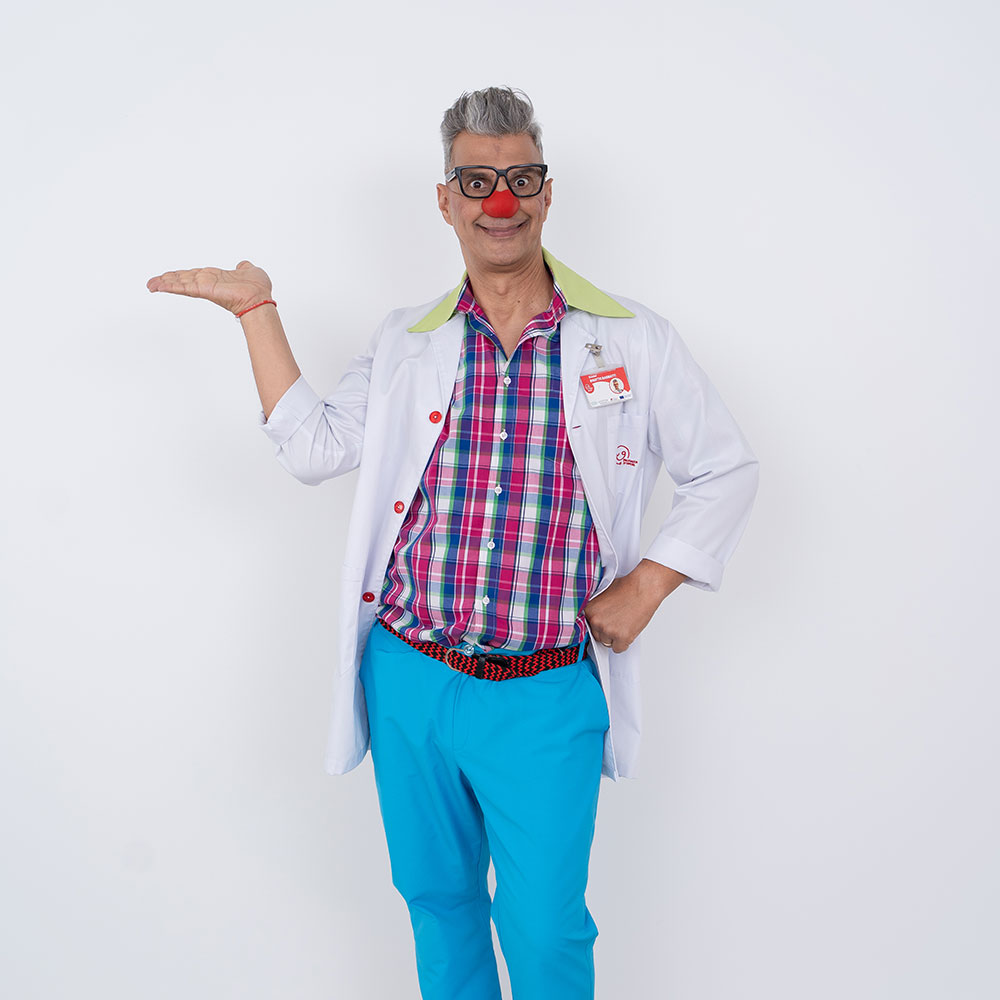
Who does our art reach?
Older people in hospital
We reduce the loneliness of hospital stays through humour and affection, and make sure smiles remain part of older people's routine.
Those who accompany and care for them
Our work also reaches family members, carers and healthcare professionals, easing daily stress and strengthening the interaction between the person who is ill, their companions and health services.
Partner hospitals
We work to make humanisation a daily practice, and we share concrete data on the changes achieved with each hospital.
Join this mission